Showing posts with label Brazil. Show all posts

Thursday, 17 December 2015

93% of Brazilian internet users use WhatsApp

"Brazilians had complained bitterly on social media about the suspension of WhatsApp, which is a hugely popular app used by many to communicate with family, friends and colleagues both inside of Brazil and abroad.
Ninety-three per cent of the country's internet population use WhatsApp, according to the TechCrunch website, with many young and poor Brazilians taking advantage of its free text message and internet telephone service.
Within hours of the suspension being coming into force, the hashtag #Nessas48HorasEuVou (#Inthese48hoursIwill) began trending on Twitter, with Brazilians joking about all the things they would do during the suspension."
Source:  BBC News, 17th December 2015

Thursday, 3 July 2014

Internet use in Brazil dropped when Brazil was playing World Cup games

"Soccer is religion in Brazil, some say. But don't take their word for it, just check the numbers.
When Brazil plays its World Cup games, available ad inventory in the country plummets 37%, according to ad-tech company Triggit, which serves nearly 2 million ads in the country each hour.
There are, of course, many websites without ads, so this is just a rough indicator. But it's a strong signal that far less web surfing occurs as the games get played.
"Normal ad data is pretty esoteric stuff and it's neat to see the real world playing out in our numbers," said Triggit CEO Zach Coelius.
When the games end, available ad inventory spikes to an average of over 27% above normal in the next two hours, meaning the country jumps back on the net in a hurry."

Monday, 16 June 2014

Over a third of online news users in 10 markets access news from their smartphones each week

"This year’s data provide further evidence of a new wave of disruption and change in digital news. In particular, we see mobile and social consumption reaching a new level of intensity, we see the different behaviours of young and old becoming more pronounced, and new kinds of journalistic organisation emerging.
The use of smartphones and tablets has jumped significantly in the past year, with fewer people using their computers for news. More than a third of online news users across all countries (39%) use two or more digital devices each week for news and a fifth (20%) now say the mobile phone is their primary access point.
The number of people paying for digital news has remained stable over the past 12 months, although we have seen a significant switch to more valuable ongoing digital subscription in most countries.
Our new (and unique) social media index for news shows Facebook is by far the most important network for news everywhere. Although Twitter is widely used in the US, Spain, and the UK, it is far less influential in many other European countries. Google+ is emerging as increasingly important for news, along with messaging application WhatsApp.
European respondents remain strongly committed to news that tries to be neutral (or impartial) but Americans are more interested in hearing from brands and reporters that are open about their own views and biases.
Traditional brands remain strong in most markets, with cross-platform newspaper reach averaging 75% in most countries, but pure players and aggregators are now more or as popular in the US, Japan, and Brazil.
US social sharing news sites like Huffington Post, Buzzfeed, and Upworthy are beginning to make inroads around the world, with new formats and a fresh tone of voice aimed at younger people. Our survey shows a new category of weird news proving more/as popular than entertainment news.
Rapid Growth in Both Mobile and Tablet Use for News
Over the past year we have seen another significant jump in the adoption of both smartphones and tablets for news – as consumers embrace the benefits of smaller, personal, always-on devices. Germany and France have had a catch-up year, while others like Denmark have surged further ahead with 52% of the sample using a smartphone for news and 34% using a tablet on a weekly basis.
37% access news from smartphone each week
On average over a third of our global sample (37%) is accessing news from a smartphone each week and one in five (20%) from a tablet. In turn, this is driving more frequent access to news and from more locations."
Source:  Data from Reuters' Digital News Report 2014, conducted by YouGov, released June 2014
Note 1 - Lots more data available at the link.
Note 2 - Markets surveyed were US, UK, Germany, France, Denmark, Finland, Spain, Italy, Brazil and Japan 

Friday, 26 April 2013

New product innovation is shifting from developed to emerging markets

"We can see this recent shift take form if we focus on new product innovation between 2008 and 2012. In 2008, the world’s 26 developed market countries, which include the U.S., Great Britain, France, Germany and Canada, generated 75 percent of global new product innovation, while the 47 emerging markets launched the remaining 25 percent.
In 2012, however, emerging market countries like China, Brazil, India and Mexico stepped up their innovation efforts and entered the list of top 10 innovative markets. Overall, the emerging markets contributed 31 percent of the world’s new product innovation in 2012, while innovation in developed markets dropped to 69 percent."

Monday, 11 March 2013

Brazil - Key insights

"Key insights from the 2013 Brazil Digital Future in Focus (#FiFBrasil) report include:
Consumers in Brazil spent more than 27 hours per month online on their desktop computers, representing the highest average engagement of all 8 Latin American markets analyzed. (Source: comScore MMX)
The Brazilian internet audience is very young on average, with 18 percent of users age 18-24 and 30 percent of all users age 25-34. (Source: comScore MMX)
Mobile phones and tablets are becoming more important to the Brazilian internet landscape. Page views from Non-PC devices (i.e. smartphones and tablets) reached an all-time high at nearly 6 percent. (Source: comScore Device Essentials)
Online Retail continues to grow in Brazil with the total number of category page views up 9 percent during 2012. Mercado Livre remains the top Retail property, reaching more than 14 million visitors in December. (Source: comScore MMX)
Online Advertising is on the rise, with more than 789 billion display ad impressions delivered in 2012. Portals and Social Networking are the two largest content categories for delivery of these ads, representing a combined 45 percent of the market. Dafiti.com.br was the largest display advertiser in Brazil with more than 25 billion ad impressions in 2012. (Source: comScore Ad Metrix)
Social Media sites capture the largest percentage of consumers’ time in Brazil at 36 percent. Facebook has emerged as a strong leader in the category with nearly 44 million unique visitors in December 2012, up 22 percent vs. year ago. (Source: comScore MMX)
Online video consumption in Brazil grew 18 percent in 2012. Google Sites (YouTube) remains the top video property, while VEVO ranks second. Facebook was one of the fastest-growing online video properties with a gain in its video-viewing audience of more than 400 percent. (Source: comScore Video Metrix)"

Monday, 25 February 2013

Pre-Pay vs Pay-As-You-Go mobile contracts by market


Click to enlarge

Source:  NielsenWire, 19th February 2013
Note - the UK figures seem wrong (only 17% of UK smartphone owners on pre-pay) - & the second chart seems to contradict it - "50% paid for data using a fixed monthly charge" - see below


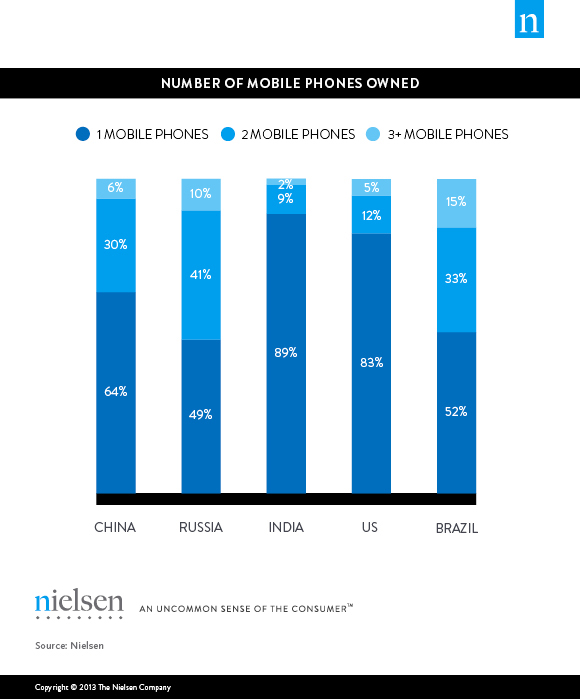
The number of mobile phones per user in the US & BRIC countries


Click to enlarge

Source:  NielsenWire, 21st February 2013

Thursday, 14 February 2013

Norway has the highest average penetration of new technology

"Within these 19 markets (see the following page for a complete list) we have tracked the adoption of three new media technologies – IPTV, smartphones and tablets – and forecast their penetration to 2015.
Across these markets smartphones are the most prevalent device, with an average 36% penetration in 2012. Smartphone penetration varies widely among our 19 markets, from 73% in Sweden to 18% in Brazil. In all markets penetration is rising rapidly, and we forecast it to double to 72% across all 19 markets by 2015, reaching 33% in Brazil and 93% in Sweden.
Tablet penetration averaged 5% in 2012, but exceeded 15% in five markets: Australia, France, Ireland, the Netherlands and the USA. By 2015 we expect penetration to average 13% across the 19 markets, but to range as high as 45% in France and 50% in Ireland.
IPTV is the slowest-growing of the three technologies; we expect its average penetration to rise by 36% between 2012 and 2015, from 6.6% to 9.0%. IPTV also has the widest range of adoption among our 19 markets; by 2015 we expect its penetration to reach 91% in the Netherlands, but remain at 1% in Russia.
Looking at the individual markets, Norway had the highest average penetration in 2012, thanks to its high take-up of smartphones (65%, compared to an average 44% in these 19 markets) and tablets (13%, compared to a 9% average). Sweden and Denmark also feature in the top five, reflecting Scandinavia’s traditional consumer enthusiasm for the internet and digital media. In fact, despite the continued economic troubles in the region, all of the top five markets were in Western Europe. The highest-ranked market from outside Western Europe was Canada, in sixth place. Australia, in seventh place, was the highest-placed market from Asia Pacific, while Hungary was the highest-placed from Central & Eastern Europe, at 16th. Brazil, at 17th, is the only Latin American market among our top 19.
By 2015, however, we expect the Netherlands to take the top position. This is thanks to its extremely rapid adoption of IPTV, which broadband providers are competing to offer as a value-added service to take advantage of the fast-paced build-out of new fibre-optic infrastructure. The swift growth of IPTV has already started eroding the number of subscribers to cable and satellite TV. We estimate that in 2012 27% of households in the Netherlands had IPTV, up from 10% in 2010. By 2015 we forecast IPTV to be in 91% of Dutch households. This is much higher than the penetration we forecast in the second-ranked market for IPTV – Canada, where we forecast 69% penetration in 2015."
Source:  ZenithOptimedia New Media Forescast, 11th February 2013
Note - the markets were:  Australia, Brazil, Canada, China, Denmark, France, Germany, Hungary, Ireland, Israel, Japan, Netherlands, Norway, Russia, South Korea, Spain, Sweden, UK, & USA

Wednesday, 9 January 2013

The number of Twitter accounts by country


Click to enlarge

Source:  Data & Analysis from Semiocast, published 30th July 2012
Note 1 - more data in the full article
Note 2 - These are obviously just estimates (from July 2012), not official figures

Monday, 3 September 2012

Countries with the greatest number of active iOS & Android devices


Click to enlarge

Source:  Blog post from Flurry, 27th August 2012
Note - Flurry calculate these figures by looking at app downloads

Thursday, 30 August 2012

62% of consumers across 12 markets use social media while watching TV

"The results of Ericsson ConsumerLab's annual study - presented in the TV & Video Consumer Trend Report 2012 - reveal that social TV is becoming a mass-market phenomenon.
Sixty-two percent of consumers use social media while watching TV on a weekly basis, an increase of 18 percentage points in one year. By gender, 66 percent of women engage in this behavior, compared to 58 percent of men. Twenty-five percent of consumers use social media to discuss what they are watching while they are watching it.
Niklas Rönnblom, Ericsson ConsumerLab Senior Advisor, says: "Mobile devices are an important part of the TV experience, as 67 percent of consumers use smartphones, tablets, or laptops for TV and video viewing. Furthermore, sixty percent of consumers say they use on-demand services on a weekly basis. Watching TV on the move is growing in popularity, and 50 percent of the time spent watching TV and video on the smartphone, is done outside the home, where mobile broadband connections are facilitating the increase."
Although viewing behaviors and demands are changing, only 7 percent of consumers say they will reduce their TV subscriptions in the future. In fact, instead of looking to cut costs, consumers are willing to pay more for an enhanced viewing experience: 41 percent of consumers say they are willing to pay for TV and video content in HD.
More than half of consumers want to be able to choose their own TV and video content. Rönnblom says: "As the number of screens and services increase, people are eagerly looking for an easy-to-use, aggregated service that can bring everything together. It should allow consumers to mix on-demand and linear TV including live content, facilitate content discovery, leverage the value of social TV and provide seamless access across devices.""
Source:  Press release from Ericsson, 28th August 2012
Methodology:  "Data was collected in Brazil, Chile, China, Germany, Italy, Mexico, South Korea, Spain, Sweden, Taiwan, UK and the US. In all, 14 qualitative and 12,000 quantitative online interviews were conducted representing more than 460 million consumers."
Full presentation here

Wednesday, 8 August 2012

Mobile Search and the Olympic Games

Google have looked at some stats across the world, combining tablet and mobile to create this chart.


Click to enlarge

Source:  Google Mobile blog, 6th August 2012
Note - lots more background at the original link

Friday, 15 June 2012

China is the world's third largest spender for Entertainment and Media

"China passes Germany in 2011: Thirteen countries in 2011 had E&M spending above $25 billion, led by the United States at $464 billion. China passed Germany in 2011 to become the third largest E&M market in the world. Brazil overtook South Korea in 2011 and during the next five years will pass Canada and Italy to become the seventh largest market."
Nore - Lots more stats and data available

Friday, 27 April 2012

A fifth of online shoppers buy with smartphones

"Payment processing firm WoldPay released its Global Online Shopping Report, which surveyed 15 countries on their e-commerce behaviours in order to uncover differences between nations. It found that on average 22% of disposable income was spent online internationally.
Furthermore, in general the percentage of income spent was higher in emerging markets. Taking the lead is India, where respondents spend 36% of their disposable income on purchasing products or services online.
In China this figure fell slightly to 31% of income spent on e-commerce, and Brazilians were clocked a as dedicating 27% of their earnings in this fashion.
The survey found the spending amounts in mature markets are the highest in the UK, where people spent a quarter of their disposable income on online goods and services, whereas peoples in Finland spend only 13%. Spain and France allocate 17% and 19% of their income respectively.
The proliferation of smartphones has opened up different channels for shoppers to make their purchase, another factor that is proven to vary across the markets.
The survey found that just under a fifth of all online shoppers globally use their smartphone to make a purchase, with people in China using this method the most, (46%), and France coming in last with this metric at 7%."
Source:  Research by WorldPay, reported by UTalkMarketing, 27th April 2012

Tuesday, 24 January 2012

Tumblr gets 15bn page views a month

"At the Digitial Life Design (DLD) conference in Munich, Germany, Tumblr founder and CEO David Karp announced that the blogging site now reaches 120 million people and 15 billion pageviews every month.
According to The Next Web, Karp credited the site’s sociability for its growth. The average Tumblr blog is re-blogged nine times, said the founder, and the content is distributed through RSS, Facebook, Twitter and other social networking platforms.
“There’s the spreadable future of social media,”  quipped journalist and professor Jeff Jarvis on Twitter.
That adds up to 560 million people who have viewed content on Tumblr to date. There are 249 million visitors in the U.S. alone, comprising 45% of Tumblr’s audience. Next in line are Brazil with 49 million visits and the UK with 34 million visits."

Friday, 4 November 2011

2/3 of college students would rather have an internet connection than a car


Click to enlarge

Source:  Taken from Cisco's World Technology Report, September 2011
Press release here
Methodology - 1,400 college students aged 18-23 & 1400 young professionals under 30.
The survey was translated into local languages and fielded in 14 countries to gain approximately
100 completes for each subgroup in each country
Countries: United States, Canada, Mexico, Brazil, United Kingdom, France, Spain, Germany, Italy,
Russia, India, China, Japan, Australia

Monday, 24 October 2011

6% of shopping searches in Brazil come from mobile devices

"Across Latin America, smartphones and mobile broadband subscribers are growing at a high rate and have in turn driven the mobile strategies of wireless operators. Today, Brazil is No. 5 in the world in number of Internet users and is second to China in growth of 3G subscribers year-over-year.
“The mobile Web is exploding in Brazil, helped with the increase of prepaid data, which is cheaper than going to cyber cafes and also more private,” noted Google’s head of mobile advertising for Latam, Peter Fernandez, during the Mobile Marketing Association Forum in São Paulo.
People are changing their lifestyle and how they consume information. Companies, as well as advertising agencies, carriers and applications developers have to understand that and move forward to provide these new customers what they demand.
“Now, 6% of shopping searches in Brazil are coming from mobile. It’s a 700% growth compared to the past year, and eight times faster than desktops,” noted Fernandez."